
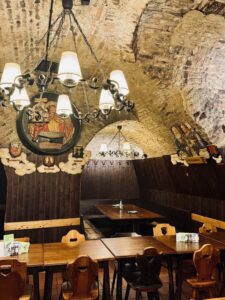
 If you think you’ve seen Vienna, think again. There is a hidden world under Vienna that most people walk past without ever noticing.
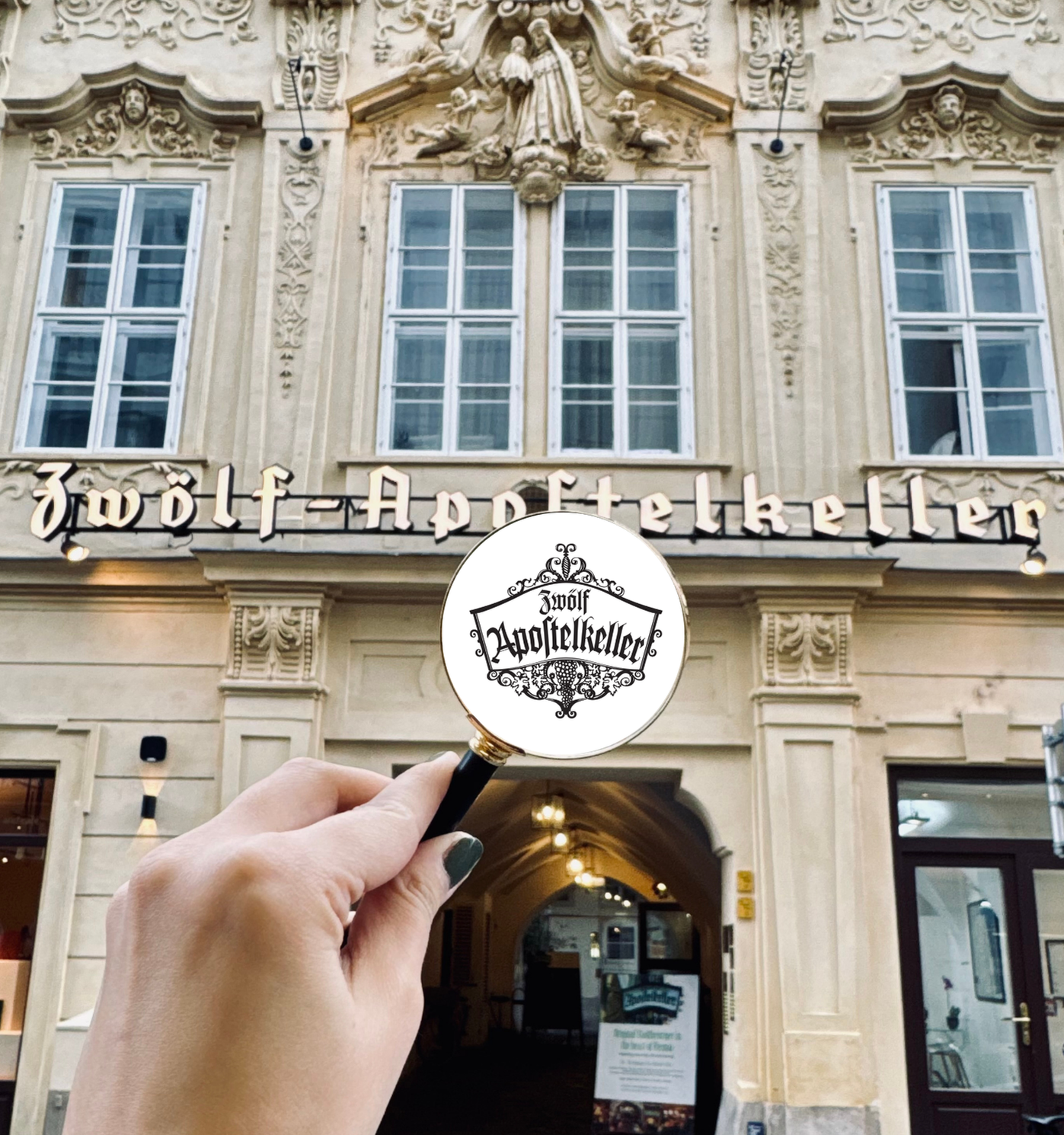
A few steps from Stephansplatz, behind a simple baroque entrance, a staircase leads down into one of the oldest cellar restaurants in the city: Zwölf Apostelkeller (12A). Even the English name sounds like something from a movie: The Twelve Apostles’ Cellar.
Stepping inside is like stepping into another time.
Thick stone walls, vaulted ceilings, iron chandeliers, wooden tables and the gentle glow of candles.
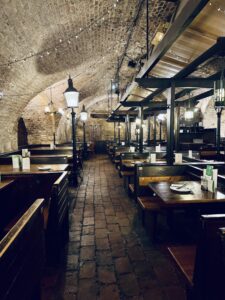 One would expect cold air — it is a cellar, after all. However, the first thing you notice is warmth. Real, surprising warmth.
This is not the kind of place where you sit in your coat. Guests comfortably dine in short sleeves, even in winter.
It is this contrast, that makes Zwölf Apostelkeller memorable: medieval stone paired with the lively atmosphere of a traditional Viennese tavern.
The cellars reach up to 18 meters below ground, and the oldest parts date back nearly a thousand years. Some sections survived wars and fires; others still show architectural traces of the Romans, the Middle Ages, the Baroque period and the Austro-Hungarian Empire.
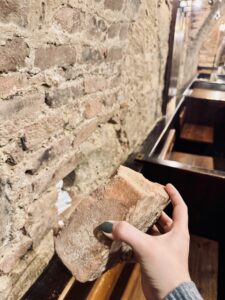 During the Second World War, small openings in the cellar walls were used to pass secret messages from below to the streets above. Today, only one remains visible, sealed but intact. The broken bricks are original — I even held one in my hand. For a moment, this was no longer a restaurant, but Vienna’s history in my palm.
Most restaurants tell stories through decoration.
Here, the story is the building itself.
Apostles, Clocks and Architecture
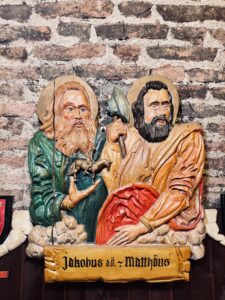 At the entrance to the main hall stands a life-sized wooden apostle. It watches over the room like a silent host, adding a touch of theatre without turning into a theme.
The Apostles’ Hall is one of the most distinctive spaces. Twelve carved wooden figures stand along the walls, each holding the symbol of his life or martyrdom:
- Peter – key to Heaven
- Philippus – bow
- Matthäus – halberd
- Paulus – sword
- Johannes – chalice
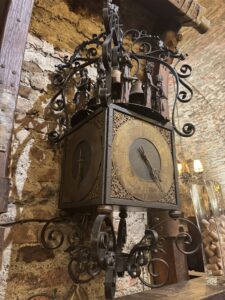 Additionally, the Aposteluhr — a 17th-century apostles clock — hangs nearby. The original is in the Vienna Clock Museum. Zwölf Apostelkeller displays a historic replica with ironwork, bells and Roman numerals.
The deepest room, the Brunnenkeller, feels older than the rest. Rough stone, soft lighting, and the original well that once supplied the building with water create a quieter, atmospheric space ideal for long dinners.
A Short Journey Through Time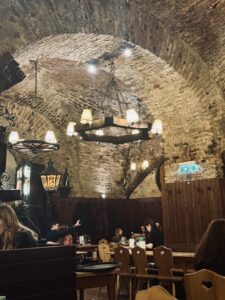
- 1100 – Lower cellar built in Romanesque stone
- Before 1500 – Gothic upper cellar added
- 1339 – First documented mention
- 1561 – Rebuilt in early Baroque (the date remains carved in stone)
- 1529 & 1683 – Used as shelter during the Turkish sieges
- 1716–1721 – Façade redesigned by Lukas von Hildebrandt
- 1952 – Opened to the public as Zwölf Apostelkeller
Live Music and Conversation
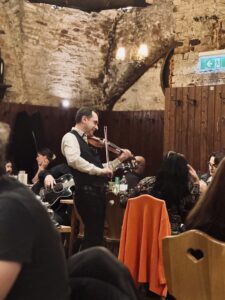 Every evening, a violinist and guitarist move from table to table. They play quietly enough for conversation to continue naturally. If you request a song — Edelweiss, The Sound of Music, a Strauss waltz — a small tip is customary.
Bringing €10–20 in cash is thoughtful and avoids the awkward moment when a musician looks at you kindly and you realise you only have a credit card.
Because the cellar is so deep, phones lose signal. Therefore, people talk to each other, laugh and enjoy the evening without screens. It creates a warm, very “old Vienna” kind of night.
What Makes Zwölf Apostelkeller Special
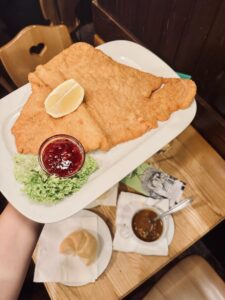 The restaurant holds around 450 seats, spread across three floors. Two large halls and several smaller rooms allow the space to stay cosy rather than chaotic. Therefore the waiters carry large wooden serving boards are carried on their shoulders, which I find very Beisl-wise.
Zwölf Apostelkeller serves traditional Austrian dishes in generous portions: Wiener Schnitzel, Roast Pork, Brettljause, Kaiserschmarrn, Applestrudel. These are classics that belong in a cellar like this.
I ordered the Gulaschsuppe nach Art des Hauses and the Wiener Schnitzel vom Kalb. The goulash soup was rich with flavour, warming and actually I wanted to order another portion. Then the Schnitzel arrived golden, thin and larger than the plate — perfectly traditional.
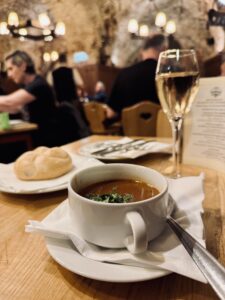 To drink, a glass of Kattus Sekt Brut, bottled especially for Zwölf Apostelkeller. Light on the tongue, refreshing, and surprisingly good with warm Austrian dishes.
Considering the restaurant’s central location, prices are fair. House wine starts at €6.20, which is unusual for the first district. I skipped dessert only because the schnitzel left no space for rational decisions. Next time: dessert first, schnitzel second.
Reservations
Because Zwölf Apostelkeller is popular year-round, especially in winter, reservations are wise.
During late November and December, booking 1–2 weeks in advance is recommended.
Once seated, guests are not rushed, which is rather unusual for the 1st district.
It works for families, couples, groups, locals and visitors — essentially anyone younger than 900 years.
Final Verdict
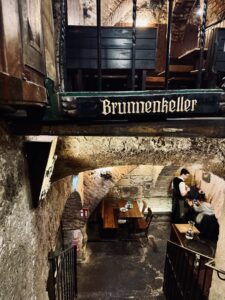 Zwölf Apostelkeller (12A) is not a theme restaurant. It does not imitate Vienna, it is Vienna.
Schnitzel, wine, stone walls, candlelight, musicians, old architecture and people enjoying themselves all in one place. It is imperfect in the best possible way: lively, human and full of character.
Would I return? Absolutely. Next time, dessert comes first.
Until Vienna whispers to you again,
Lili
Your trusted concierge in Vienna 
📍 Zwölf Apostelkeller (12A)
Sonnenfelsgasse 3, 1010 Wien
🍽 Traditional Austrian cuisine in a 900-year-old cellar
💳 Cash & card accepted
🕰 Daily from 11:00-00:00h
📞 Reservations recommended, especially in winter
🔗 https://www.zwoelf-apostelkeller.at/
Vienna – the Conwienient way